

Designing for the Senses: A Sensory Landscape Design Approach to Supporting Neurodiversity
Outdoor environments play a critical role in supporting sensory comfort, regulation, and wellbeing, particularly for neurodiverse users.
Increasingly, research highlights the relationship between designed outdoor environments and sensory sensitivities, emphasising the importance of sensory landscape design
that responds to diverse user needs rather than a single “typical” experience. (Finnigan, K. A., 2024)
This has been a longstanding area of interest for Senior Landscape Architect and Melbourne Studio Landscape Lead, Srivani Manchala, who explored ‘Autism and the Built Environment’ as part of her architecture and landscape architecture thesis. Srivani’s research demonstrated how carefully structured, sensory-informed settings can reduce stress and support engagement for children with special needs.
As Srivani explores in this article, framing landscape design for wellbeing through the lens of human sensory experience enables more inclusive landscape design outcomes that improve legibility, support self-regulation, and enable greater independence and participation.
What is Sensory Landscape Design?
Sensory landscape design (also referred to as sensory design in outdoor environments) is an approach that considers how people experience space through sight, smell, sound, touch, and movement.
Translating sensory-led principles into built outcomes requires a deliberate and coordinated design response. Each sensory element, while considered individually, must work together to create responsive environments that balance stimulation and calm, while maintaining predictability, refuge, and clarity within the built environment. This approach aligns with broader neuro-inclusive design principles, to create environments that are adaptable and accessible to a wide range of users.
The following strategies outline how targeted landscape interventions can be applied across different senses.
Sight: Supporting Clarity and Reducing Visual Overload
Visual overstimulation can be a key barrier in outdoor environments. A curated planting strategy that incorporates defined structure, filtered light, and restrained tonal variation helps create calming landscape design outcomes that are easy to interpret. Clear sightlines and spatial legibility are essential to inclusive landscape design, as they support intuitive wayfinding and help reduce cognitive load.
Smell: Olfactory for Familiarity and Orientation
Olfactory cues can contribute to design for sensory regulation but should be applied with care. Overly intense scents can become overwhelming, particularly for individuals with sensory sensitivities. Low-intensity, familiar planting such as Australian natives, can reinforce identity and orientation, to create accessible outdoor environments that feel predictable and comfortable.
Hearing: Managing Acoustic Comfort
Acoustic comfort is a critical but often overlooked element of sensory design in outdoor environments. Natural soundscapes such as water, wind through planting, and birdlife, are associated with reduced stress and improved mood, while mechanical noise (like traffic) can have the opposite effect (Ahmadi, E., et al., 2026).
Landscape strategies such as planting buffers, earth mounding, and material selection can support green space wellbeing design, help to filter noise and improve environmental conditions. In sectors including education, health and wellbeing, or corrections, access to quieter outdoor breakout areas can provide essential relief from internally controlled or high-stimulus settings, supporting both user wellbeing and individual performance.
Touch and Feel: Supporting Grounding and Engagement
Tactile experience plays a significant role in sensory responsive environments. Carefully selected materials that provide variation without risk, support sensory engagement while maintaining comfort and safety.
Research into sensory gardens and outdoor therapeutic environments shows that interaction with natural materials can positively influence sensory, emotional, and social wellbeing, particularly for neurodiverse users (Wagenfeld, A., et al., 2019). Subtle changes in texture underfoot, edge conditions, and seating elements can also help signal transitions and reinforce spatial awareness.
Supporting Movement and Wayfinding in Outdoor Environments
Clear movement networks are fundamental to inclusive and accessible outdoor environments. Clear sight lines, legible paths, and consistent edges provide a framework for intuitive use. Wayfinding research demonstrates that people rely on environmental cues, spatial structure, and familiarity to navigate effectively, particularly in complex environments (Alinaghi, N., et al., 2025).
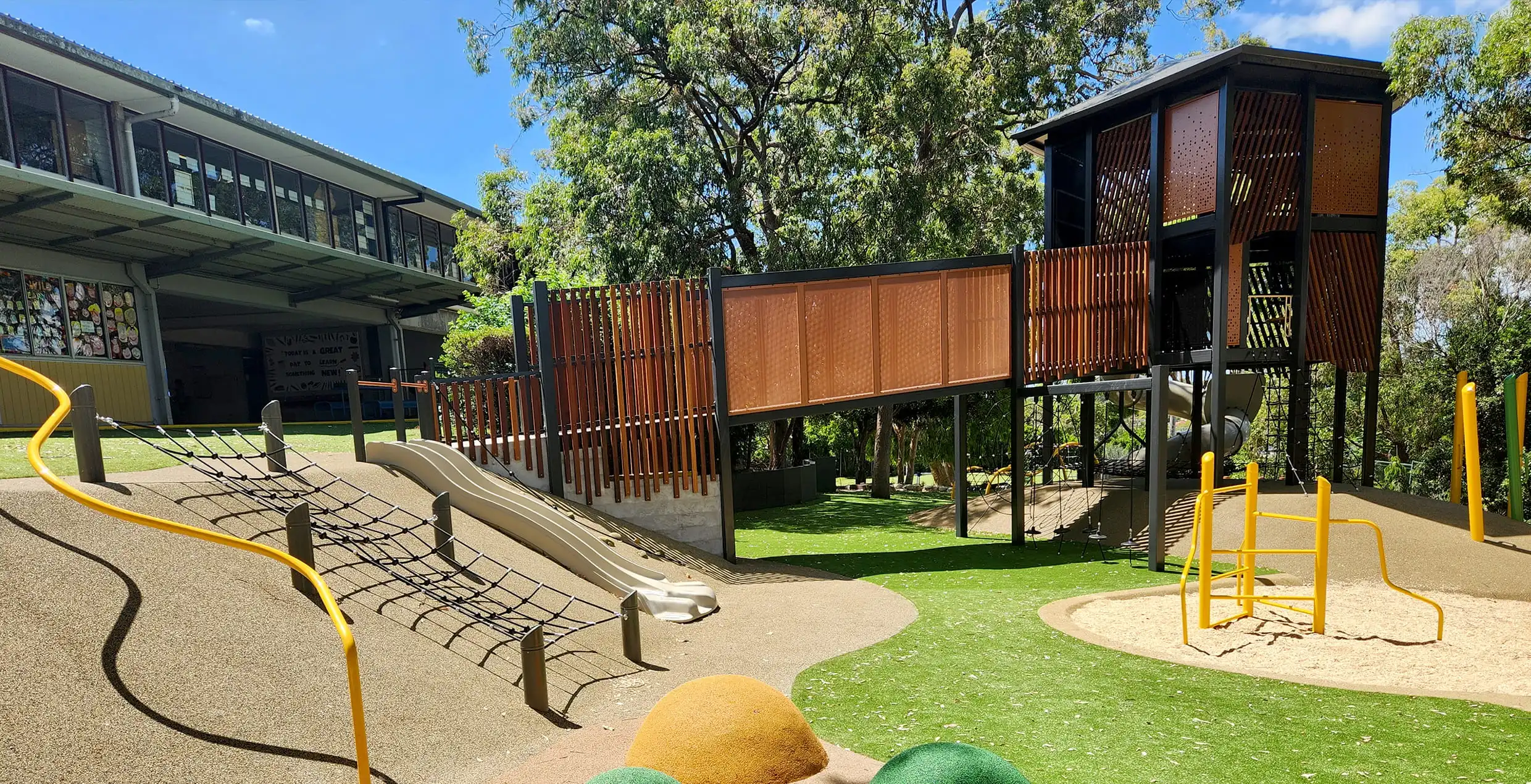
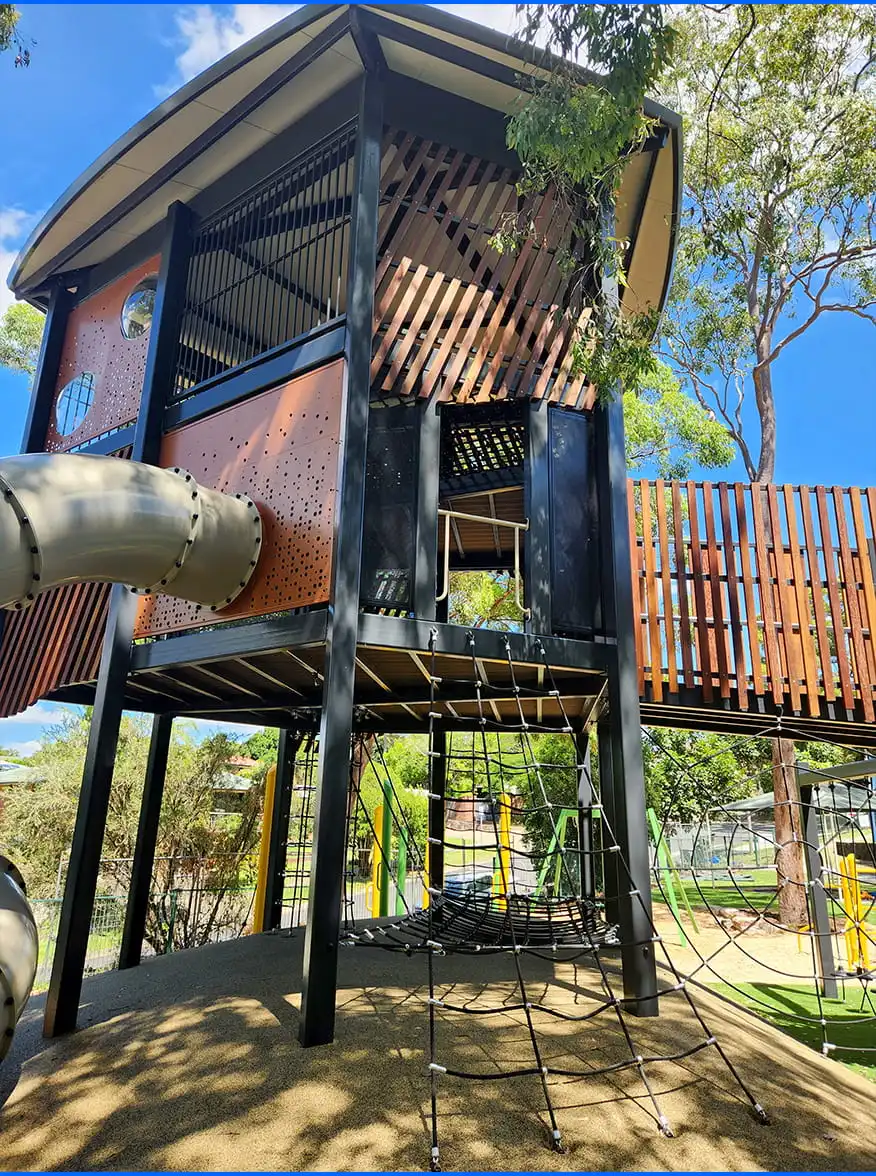
In projects with sensitive user groups, such as education, sports, recreation, or justice environments, predictable circulation networks can significantly reduce anxiety and support independence. A strong example of this is the landscape design for the multi-award-winning St Catherine’s Catholic Primary School Playspace.
Delivered in collaboration with Ausplay, the design integrates seven key domains of play – physical, challenge, perceptual, social, spatial, imaginative, and cognitive – providing a diverse range of play experiences for children of all ages and abilities. The playspace draws on sights, sounds, terrain, and activities experienced in nature when on a bushwalk, using familiar natural cues and transitions to support movement, exploration, and self-directed play.
Designing Transitions for Neuro-Inclusive Spaces
Transitions between indoor and outdoor environments are often where sensory discomfort is most pronounced. Sudden changes in light, temperature, or sound can be difficult to process. Designing clear sequences through buffer zones, shading, and controlled indoor/outdoor interfaces supports sensory regulation. This helps with predictability, comfort and autonomy.
Landscape Design for Wellbeing and Inclusion
A sensory landscape design approach is not about simplifying environments but about designing with clarity and purpose.
A growing body of evidence demonstrates that access to well-designed green space is linked to reduced stress, improved mood, and broader mental health benefits across diverse populations (Barton, J., & Rogerson, M., 2017).
In more controlled settings, such as correctional environments, research has also shown that access to green space can support emotional regulation, reduce stress, and contribute to improved behavioural outcomes, reinforcing the role of landscape architecture in mental health and wellbeing (Moran, D., et al., 2023).
By embedding sensory design principles into the design process, landscape becomes an active contributor to wellbeing, not simply as an aesthetic overlay. By embedding sensory considerations into the design process, landscapes can support a wider range of users, enabling more inclusive, adaptable, and resilient environments.
Frequently Asked Questions
What is sensory landscape design?
Sensory landscape design is an approach that considers how people experience outdoor environments through sight, sound, smell, touch, and movement. It creates sensory responsive environments that support comfort, reduce stress, and improve usability for a diverse range of users, particularly those with sensory sensitivities.
Why is sensory landscape design important in outdoor environments?
Sensory design in outdoor environments is important because public spaces can be highly stimulating and unpredictable. A sensory landscape design approach helps regulate these conditions by reducing visual clutter, filtering noise, and creating clear, legible spaces. This improves overall wellbeing and enables users to engage more comfortably and confidently with their surroundings.
How does landscape design support neurodiversity?
Designing for neurodiversity in landscape architecture can support neurodiverse users by:
- Reducing sensory overload through structured planting and materials
- Improving wayfinding with clear paths and spatial cues
- Providing quiet breakout spaces for sensory regulation
- Designing gradual transitions between different environments
These strategies help create accessible outdoor environments that are more inclusive, predictable, and supportive of individual needs.
What are key features of a sensory-friendly landscape?
A sensory-friendly landscape design typically includes:
- Structured planting palettes for calming landscape design
- Low-intensity and familiar planting species
- Acoustic buffering through vegetation
- Varied but safe material textures
- Clear pathways and wayfinding
- Spaces for retreat and sensory pause
Together, these elements support green space wellbeing design and sensory regulation.
How do sensory transitions improve user experience?
Designing for sensory regulation through transitions is critical for user comfort. Transitions between spaces, particularly indoor to outdoor, can be challenging due to sudden changes in light, sound, and activity levels. Designing gradual transitions through buffer zones, shading, and spatial sequencing supports neuro-inclusive design outcomes that prioritise predictability, autonomy, and ease of movement.
Can sensory landscape design benefit all users, not just neurodiverse individuals?
Yes. While sensory landscape design is particularly beneficial for neurodiverse users, it enhances comfort, clarity, and wellbeing for everyone. Calm, legible, and well-structured environments support broader community use, including children, older people, and those experiencing stress or fatigue supporting wellbeing outcomes through landscape design.
References
Ahmadi, E., et al. (2026). Urban green space soundscapes and mental health outcomes. PLOS One. https://journals.plos.org/plosone/article?id=10.1371/journal.pone.0344125
Alinaghi, N., Giannopoulos, I., Kattenbeck M., & Raubal M. (2025) Decoding wayfinding: analyzing wayfinding processes in the outdoor environment, International Journal of Geographical Information Science, 39:8, 1770-1800, DOI: 10.1080/13658816.2025.2473599. https://www.tandfonline.com/doi/pdf/10.1080/13658816.2025.2473599
Barton, J., & Rogerson, M. (2017). The importance of greenspace for mental health. BJPsych International, 14(4), 79–81. https://pmc.ncbi.nlm.nih.gov/articles/PMC5663018/?lang=en/
Finnigan, K. A. (2024). Sensory responsive environments: A qualitative study on perceived relationships between outdoor built environments and sensory sensitivities. Land, 13(5), 636. https://www.mdpi.com/2073-445X/13/5/636
Moran, D., Jordaan, J., & Jones, P. (2023). Green space in prison improves wellbeing irrespective of prisoner characteristics. European Journal of Criminology. https://pure-oai.bham.ac.uk/ws/portalfiles/portal/203900084/moran_et_al_2023_greenspace_in_prison_improves_well_being_irrespective_of_prison_er_characteristics_with_particularly.pdf
Moran, D. (2019). Back to nature? Attention restoration theory and the restorative effects of nature contact in prison. Health & Place. https://research.birmingham.ac.uk/en/publications/design-principles-for-prison-landscapes-security-biodiversity-and/
Wagenfeld, A., Sotelo, M., & Kamp, D. (2019). Designing an impactful sensory garden for children and youth with autism spectrum disorder. Children, Youth and Environments, 29(1), 137–152. https://www.elsforautism.org/wp-content/uploads/2024/09/Designing-an-Impactful-Sensory-Garden-for-Children-and-Youth-with-Autism-Spectrum-Disorder.pdf
Xu, Z., et al. (2025). Associations between urban green space quality and mental wellbeing: Systematic review. Land, 14(2), 381. https://www.mdpi.com/2073-445X/14/2/381
UP NEXT
