

Transitioning from university to a professional career is a journey filled with both excitement and apprehension. For architecture and built-environment students, this often involves the daunting task of compiling a portfolio that truly represents their skills, passion, and potential.
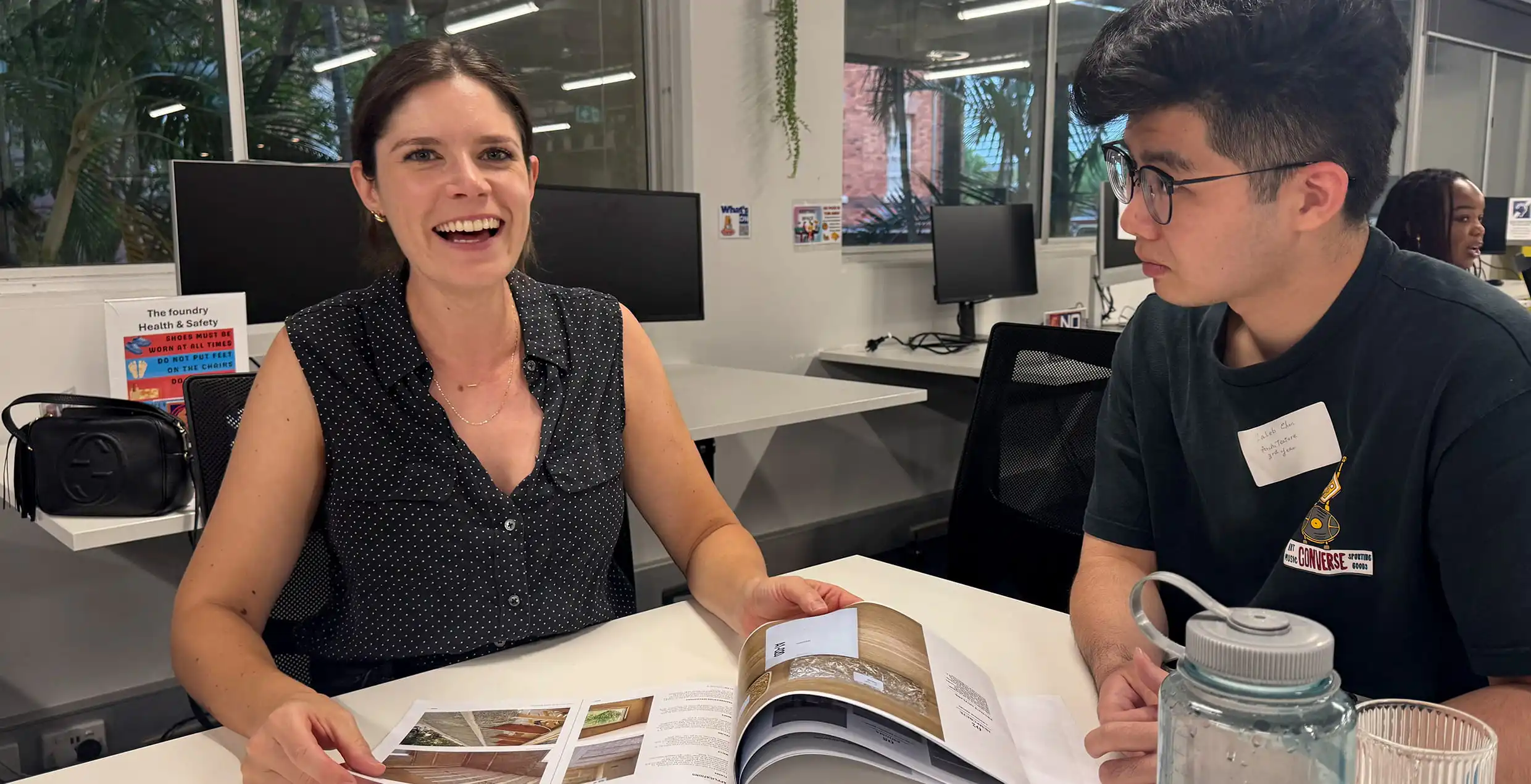
Recently, our architects Naomi Denes and Shiva Kumar had the privilege of attending the QUT Design Exchange Portfolio Review Evening, an event designed to bridge this very gap. The evening provided a fantastic opportunity for students to connect with industry professionals, receive practical feedback, and gain valuable insights.
Naomi and Shiva were impressed by the incredible work presented, but they also recognised the underlying stress and anxiety that comes with managing final-year studies while simultaneously navigating the pressures of job hunting. It was a powerful reminder of how crucial mentorship and guidance are during this pivotal time.
This experience inspired us to share some of the key takeaways and advice from that evening. We want to help you build a portfolio that not only showcases your projects but also tells the compelling story of who you are as a designer.
Tell Us Your Story, Not Just the Result
Your portfolio is more than a collection of beautiful renders. It’s a narrative about your design journey. We want to understand your thought process and the “why” behind your decisions.
Show Your Thought Process
What was the core idea that drove your design? What challenges did you encounter, and how did you solve them? Use diagrams, sketches, and brief annotations to walk us through your creative and critical thinking. Showing your process reveals your ability to tackle problems, adapt, and innovate and these are the qualities that are highly valued in any practice. A project that demonstrates a rigorous thought process is often more impressive than one that simply looks good.
Let Your Passion Shine Through
What projects are you most proud of? Which ones did you have the most fun working on? These are the projects that should take centre stage. Your enthusiasm is contagious. When you present work that you are genuinely passionate about, it resonates with the reviewer. This is your chance to show what truly excites you about architecture and design. Start your portfolio with the project that is closest to your heart. It sets a powerful and authentic tone for everything that follows.
Be Unapologetically You
In a field that often seems to favour certain aesthetics, it can be tempting to conform. However, your unique perspective is your greatest asset.
Break the Mould
Don’t feel pressured to fit into a specific template. While minimalism and monochrome layouts can be effective, they aren’t the only way. If colour and bold graphics reflect your personality and design ethos, use them. Your portfolio should be an extension of your identity. Authenticity stands out far more than conformity ever will. We love knowing the person behind the work.
Flaunt Your Unique Background
Your experiences before and outside of university have shaped you into the designer you are today. Don’t hide them, highlight them! Did you have drafting experience before starting your degree? It likely influenced the way you think about structure and detailing, and we can see that in your work.
Do you have a degree in economics? Show us how you’ve considered project feasibility. Did you grow up in another country? Explain how its architecture has shaped your design thinking. Your diverse experiences give you a unique lens that no one else has.
The Practical Details That Matter
Beyond the narrative and creative expression, a few practical details can elevate your portfolio from good to great. These small touches demonstrate professionalism and attention to detail.
Less Is More: Focus on quality over quantity. You don’t need to include every project you’ve ever worked on. Choose the projects that best highlight your skills and interests and consider tailoring your selection to fit the style or focus of the company you’re applying to. Carefully curated content makes a stronger impact.
Mind Your Language: In Australia, the term “architect” is protected. Be careful not to use it to describe yourself until you are officially registered. Using terms like “architectural graduate” after completing Masters or “architectural student” and “designer” is appropriate.
Show Off Your Software Skills: A simple and effective way to display your technical proficiency is to add small logos of the software you used for each project (e.g., Revit, AutoCAD, Adobe Creative Suite, etc.). This gives employers a quick snapshot of your capabilities.
Less Text, More Visuals: Let your work speak for itself. Use concise text and lean on diagrams, drawings, and images to tell your story. A wall of text is less likely to be read than a well-composed visual sequence.
Balance Renders with Details: While beautiful renders are important, they only show one part of the picture. Demonstrate your understanding of construction and materiality by including drafting and detailing work. This balance shows you are a well-rounded designer who can think conceptually and technically.
Consider Two Portfolios: Some students find it helpful to maintain two portfolios – an academic one that showcases their conceptual and research-based work, and a professional one tailored for job applications that highlights practical skills and relevant projects.
Network! Network! Network!
The advice to “network” can feel cliché, but its importance cannot be overstated. Events like the QUT Design Exchange are invaluable. The conversations you have and the connections you make can open doors you didn’t even know existed. Be confident, ask questions, and be genuinely interested in the people you meet. Every interaction is an opportunity to learn and grow your professional circle.
Remember Your Journey is Just Beginning
Building a portfolio can feel overwhelming, but it is also an opportunity for self-reflection. It’s a chance to look back on everything you have accomplished and define the kind of designer you want to become. Be confident in who you are and everything that has shaped your unique perspective.
Your portfolio is more than a collection of projects, it’s a reflection of your potential, your passion, and your story. Embrace it. If you are a student or recent graduate looking for more advice or mentorship, we invite you to connect with our team and check out our Student Hub. We believe in fostering the next generation of design talent and are always happy to help.
UP NEXT
