

Successful design always starts with context. Before we sketch a single line or draft a floor plan, we must understand the land we build on and the people who hold its history. For design practices, this means recognising that our work sits on unceded First Nations land. Understanding this truth is not just a professional obligation; it is a fundamental part of designing with empathy, respect, and purpose.
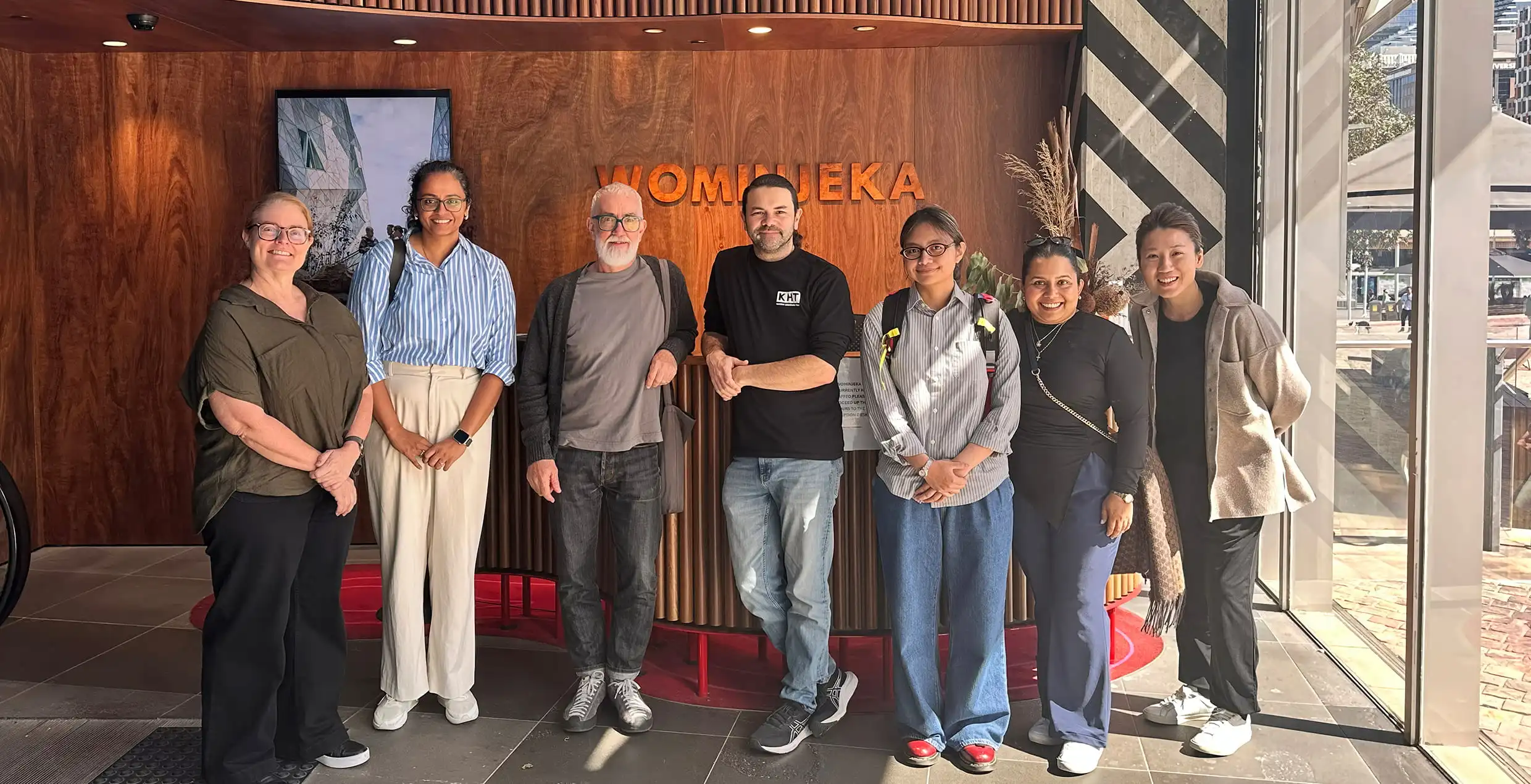
Recently, the GB-A Melbourne team took a vital step in this ongoing learning journey. Joined by other Association of Consulting Architects (ACA) members, our team attended the Building Aboriginal Cultural Competency Workshop. Delivered by and held at the Koorie Heritage Trust, at the Birrarung Building by the Birrarung River in Wurundjeri Country, this session provided rich insights into Aboriginal culture, identity, and history.
This post explores our team’s experience at the workshop, the powerful insights we gained from First Nations facilitators, and how we plan to integrate this cultural sensitivity into our future design projects.
Deepening Our Understanding at the Koorie Heritage Trust
The Koorie Heritage Trust serves as an essential hub for preserving and promoting the living culture of the First Peoples of south-eastern Australia. Walking into this space, our team prepared to listen and learn.
Tim, the KHT facilitator for the day and a descendant of the Gunditjmara people from the western district of Victoria, guided us through the complex and often painful history of Aboriginal Australia. He helped us navigate the devastating impacts of colonisation; its effect on identity, continued custody of Country and the lack of documentation recording cultural loss and dispossession.
Tim’s facilitation of the session was invaluable, offering insights through the lens of lived experience. The session featured exercises that encouraged deeper, more personal engagement, prompting reflection on our individual identities and histories. Recognising these aspects is essential for us to create a path forward, building on the lessons gained from the session.
Why Cultural Sensitivity is Crucial in Design
Architecture, interior design, and landscape architecture are inherently connected to place. Every project we undertake interacts with the environment and the local community. If we design without understanding the cultural significance of the land we work on, we risk creating spaces that erase rather than honour what came before.
Cultural competency allows us to move beyond superficial acknowledgments of Country It means engaging with Indigenous communities early in the everyday as good allies and genuinely and not as a mere consultation step near the end of the project timeline. It means asking whose Country we are on, what land has meant across generations and how our work can respond to that honestly. Scared sites, indigenous narratives and the memory held in the land are not just peripheral (superficial) considerations; they belong at the epicentre of good design thinking.
It empowers our team to engage meaningfully with Indigenous communities, ensuring that our projects respect sacred sites, reflect local narratives, and contribute positively to the built environment. When we approach our work with this lens, we create spaces that foster inclusion and healing[SM2.1]. Our team can reflect truth and contribute to a built environment that acknowledges Australia’s full history and not just the parts that are comfortable to tell.
Team Perspectives: Insights from the Workshop
The workshop left a lasting impression on everyone who attended. It provided meaningful perspectives that will continue to shape both our personal lives and our professional practices. Two of our team leaders shared their main takeaways from the day.
History, Humility, and the Built Environment
For Srivani Manchala, our Melbourne Landscape Lead, the workshop’s timeline of historical events offered a sobering perspective on the lasting impacts of systemic injustice and a personal reckoning with how recent that history truly is.
“What stayed with me most from the cultural competency workshop at the Koorie Heritage Trust was how recent this history really is, a time when the experiences and injustices faced by Aboriginal people were not widely acknowledged,” Srivani reflected. “Hearing about the apology in that context was deeply moving and made me pause to imagine the weight carried by generations who lived through it.”
As a landscape architect, Srivani understands the intimate relationship between people and the natural world. She noted how the workshop reinforced her approach to her craft. “While I have always believed that design is grounded in people, place, and context, the workshop reinforced how important it is to continue listening, acknowledging Country, and carrying that awareness with care and humility into our work.”
Lived Experience and Cross-Practice Commitment
Colie Leung, our Senior Interiors Lead, highlighted the irreplaceable value of hearing firsthand accounts and the importance of collective participation across our firm.
“Learning about First Nations history and culture from those with lived experience is something you can’t get from a book,” Colie shared. “Last week, some of us at GB-A had that opportunity, and it was really special. The more we understand, the better placed we are to push for genuine engagement on our projects.”
A standout moment for Colie was seeing the diversity of roles represented by the GB-A team at the workshop. “What I loved was seeing who showed up—architects, landscape, interiors, and even the finance team. Really proud to work somewhere that invests in that across the whole practice.”
This cross-departmental attendance proves that cultural competency is not just a concern for project managers or designers; it is a core value that must permeate every level of our business operations.
Bringing Cultural Competency into Our Practice
Knowledge alone is not enough. The true value of this workshop lies in successfully incorporating this knowledge in our practice. The insights gained from Tim and the Koorie Heritage Trust will directly influence how we further engage as allies with the indigenous community, and approach design with understanding and cultural sensitivity. The understanding gained will also inform the ongoing development of the GB-A Reconciliation Action Plan.
First, we commit to prioritising genuine engagement with First Nations stakeholders early in the design process. Rather than treating cultural consultation as a compliance checkbox, we view it as a foundational design phase. We want our spaces to tell authentic stories that honour the Traditional Owners of the land. Second, we commit to maintaining these relationships with First Nations stakeholders to foster our connection to Country.
Lastly, we will continue to foster an internal culture of learning. We recognise that one workshop does not make us experts. Cultural competency requires ongoing education, reflection, and an openness to having difficult conversations. We will keep providing opportunities for our entire team to engage with Indigenous history and culture.
Currently, GB-A is going through the journey of establishing our RAP that formally outlines our goals and actions. It draws on our experiences of engaging with First Nations in and outside of our projects over the last three decades and the future steps we want to take for more meaningful outcomes for all through the design process.
Moving Forward with Purpose
The Building Aboriginal Cultural Competency Workshop was a transformative experience for the GB-A Melbourne team. It reminded us that our work leaves a permanent mark on the landscape, and with that comes a profound responsibility.
As we return to our desks and site visits, we carry with us a renewed sense of purpose. We are dedicated to designing with care, listening with humility, and ensuring that our projects respect the deep, enduring history of Aboriginal Australia. By investing in cultural understanding across our entire practice, we take a meaningful step toward a more inclusive and thoughtful future in design.
Successful design always starts with a context. We are committed to making sure that context includes the full truth of the land we work on and the people whose connection to it runs deeper than any blueprint.
UP NEXT
